Internet Routing Protocols
Internet Routing Protocols

Routing Protocols are a collection of established guidelines that routers utilize to send and receive data
In order to exchange information that enables them to choose routes between nodes in a computer network, routers must communicate with one another according to a routing protocol. Data packets are passed from router to router over the internet’s networks until they arrive at their destination computer. Routers are responsible for traffic direction on the internet. The precise route decision is made by routing algorithms. Only the networks that are directly connected to each router are known to it. This information is distributed throughout the network through a routing mechanism, first to nearby nodes in the immediate vicinity. In this method, routers learn about the network’s topology.
What gives the Internet its fault tolerance and high availability is the capacity of routing protocols to dynamically adapt to changing situations, such as disabled connections and components, and route data around barriers.
Types of Routing Protocols
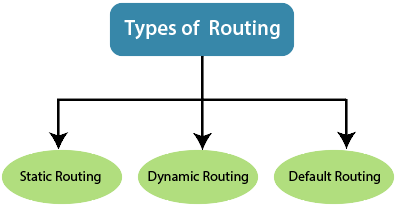
Routing can be classified into three categories:
- Static Routing
- Default Routing
- Dynamic Routing
Static Routing
When a network administrator manually designates the path from the source to the destination network, static routing protocols are used. It gives the network more security. This method does not depend routing decisions on the state or topology of the networks.
Nonadaptive Routing is another name for Static Routing.
Advantages of Static Routing
- No Overhead: The router’s CPU use is not affected at all. Therefore, static routing can be obtained with the less expensive router.
- No bandwidth: No unused bandwidth between links.
- Security: It offers security because only one network’s routing may be controlled by the system administrator.
Disadvantages of Static Routing
- The configuration of each router must be known by the administrator.
- Large networks should avoid this approach because it takes a lot of time.
- Every time a connection fails, the entire network falls offline, which is problematic in small networks.
Application of Static Routing
- When no alternative routes are available or required, static routing can be used to provide an exit point from a router. It's known as a default route.
- Small networks with only one or two routes can employ static routing. Since no link is wasted by sending dynamic routing information, this is frequently more effective.
- In addition to dynamic routing, static routing is frequently used to provide a failsafe fallback in the event that a dynamic route is unavailable.
- In order to transfer routing information from one routing protocol to another, static routing is frequently used.
Default Routing
Default routing is a method where a router is set up to send all packets to the same hop device, independent of whether that device is a part of a certain network or not. The device for which a packet is configured in default routing receives the transmission.
When networks deal with a single exit point, default routing is employed.
It is also helpful when multiple transmission networks are required to send data to a single HP device.
The router will select the specified route rather than the default route when the specific route is indicated in the routing table. Only when a specified route is absent from the routing table is the default route selected.
Advantages of Default Routing
When there isn’t a predefined route in the routing table, default routing can be used.
Disadvantages of Default Routing
A network gets harder to set up and use efficiently as it gets complex.
Dynamic Routing
With the help of the dynamic routing protocol, routers can automatically add new information to the router table after dynamically learning about other routers. The optimal route to the network added to the routing table is chosen by the routing protocol.
It is also known as Adaptive Routing.
The following points should be present in the dynamic protocol:
To exchange routes, all routers need to use the same dynamic routing protocol.
Any changes to the state or topology are broadcast to all other routers by the router if it detects them.
The dynamic routing protocol’s major objective is:
It locates a distant network and keeps up-to-date routing data.
It automatically selects the optimal route to the target network, but it also has the option to select a different route if the current one is not available.
- Configuration is simpler.
- When a condition or topology changes, it is more successful at picking the optimum path.
- It functions on all kinds of networks.
- If there is a link failure condition, immediately reroute the traffic.
- A routing table is created automatically.
Disadvantages of Dynamic Routing:
- In terms of CPU and bandwidth utilization, it is more expensive.
- Compared to default and static routing, it is less secure.
Purpose of Dynamic Routing Protocols.
- locating distant networks
- maintaining current routing data.
- selecting the most effective route to the target networks.
- the capacity to choose a new optimum path if the previously chosen one is no longer available.
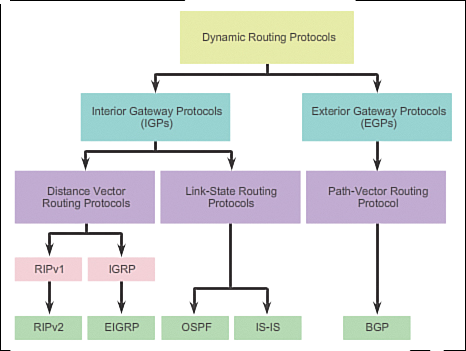
Interior gateway protocols
A routing protocol known as an inner gateway protocol (IGP) or interior routing protocol is used to exchange routing table data between gateways (often routers) within an autonomous system (for example, a system of corporate local area networks). Network-layer protocols like IP can then be routed using this routing data.
The two types of interior gateway protocols are distance-vector routing protocols and link-state routing protocols. Open Shortest Path First (OSPF), Routing Information Protocol (RIP), Intermediate System to Intermediate System (IS-IS), and Enhanced Interior Gateway Routing Protocol are some particular instances of IGPs (EIGRP).
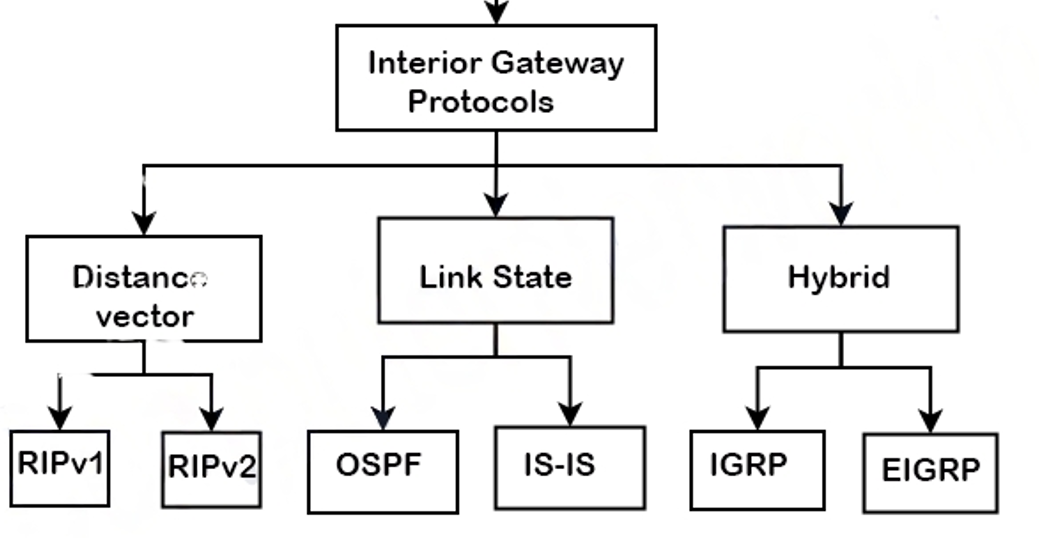
The Routing protocols are:
- Distant Vector Protocols
- Link-State Protocols
- Hybrid Routing Protocol
Distant Vector Protocols
Distant vector protocol, commonly known as the Ford Fulkerson or Bellman-Ford algorithms, is used to determine a path. From the data gathered by the neighboring router, a distance-vector protocol determines the distance and direction of the vector of the following hop. It is important to monitor the topology and alert nearby devices if there are any changes.
Let’s imagine that all of the routers are configured and using the remote routing protocol. Every router in the network will communicate the distance with the router next to it. All of the data is gathered from nearby routers. An optimal distance is determined for each router’s information and recorded in the routing table. In this manner, the distant vector routing protocol is used to determine the best path.
How DVR Protocol Works ?
Link-State Protocols
The best path is determined by Link-State Routing protocols based on the overall topology of the entire network and all associated networks. Link-state routing determines the distance from source to destination, one hop at a time, using a variety of criteria.
The neighbors table, topology table, and routing table are the three separate tables that the link-state routing protocol maintains. The information from the neighbors table is stored in the neighbors table. The routing table keeps track of all the routes to the various networks, whereas the topology table stores data about network topology. Since it has a complete image of the network, it needs greater memory and processing power.
Think about the situation where the routers are configured. The steps of the Link State Routing Protocol are as follows:
Finding the Neighbor: The first objective after routes are upgraded is to identify the neighbors. A greeting is sent to neighbors via routers. The nearby router identifies itself in response to the “Hello” message. The network addresses of the routers are added to the response. A neighbors table is created using this data.
The link-state routing protocol mandates that each router be aware of or have a fair estimate of the delay to each of its neighbors. Sending a signal over the link and calculating the end-to-end delay serve as the basis for calculating the cost of a line.
Link State Routing has two phases:
Reliable Flooding
- Initial state: Each node knows the cost of its neighbors.
- Final state: Each node knows the entire graph.
Hybrid Routing Protocol
Hybrid routing, also known as balanced-hybrid routing, combines link-state routing, which works by having each router on the network inform the others about its nearest neighbors, with distance-vector routing, which operates by sharing its knowledge of the complete network with its neighbors.
A third grouping for routing algorithms is hybrid routing. In order to find the optimum routes to destination networks, hybrid routing protocols use distance-vectors for more precise metrics and only report routing information when the network’s topology changes. Compared to link-state routing, hybrid routing has a faster convergence rate but uses less processing power and memory.
Example of Hybrid Routing Protocol
An example of hybrid routing protocol is zone routing protocol (ZRP). For route constitution within the nodes neighborhood ZRP uses proactive mechanism, it takes the advantages of reactive protocols for communication between the neighborhoods.
The Enhanced Interior Gateway Routing System (EIGRP), created by Cisco, is an illustration of a hybrid routing protocol.
Exterior Gateway Protocol
A obsolete routing protocol called Exterior Gateway Protocol (EGP) was used in autonomous systems to transmit data between neighboring gateway sites. EGP was replaced by the widely used Border Gateway Protocol (BGP), which is used by academic institutions, government organizations, and private businesses (BGP).
The foundation of the EGP is a periodic message exchange querying for neighbors reachability and poll instructions to request update answers. RFC 904 describes EGP and was published in April 1984.
Exterior Gateway Protocol is a different name for this protocol.
In the early days of the Internet, research institutions frequently connected autonomous computers using EGP, universities, government organizations, and commercial firms. However, Border Gateway Protocol finally replaced it (BGP).
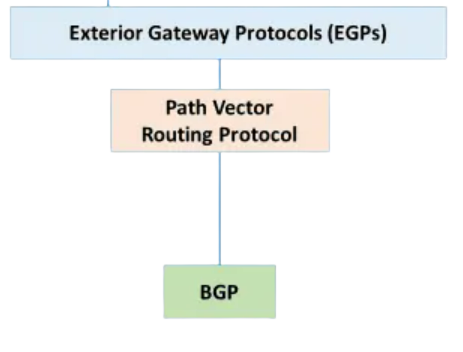
Path Vector Protocol
A routing protocol that maintains track of dynamically updated path information is the path vector protocol. The path vector protocol decides if the path is loop-free or not rather than depending on whether the destination can be reached. The path vector analyses the path to determine whether or not it contains loops.
Let’s see how path vector routing works.
Path vector routing operates on a similar principal as distance routing. It is predicated that each autonomous system has a speaker node, or a node that acts on behalf of the entire autonomous system. An autonomous system called the speaker node builds a routing table and distributes it to other autonomous systems. A speaker node in its autonomous system and surrounding autonomous systems broadcasts the path.
Functions of Router
From source to destination, the packet is routed via the router. Let’s view the router’s functionalities:
By forwarding the packets, it controls traffic inside a network.
Multiple devices can connect to the same network thanks to it.
A packet is forwarded by the router between various networks.
To choose the optimum way for a packet to go through a network, a routing protocol is used. The routers converse with one another and collect data on the many routes leading to a particular network, which they then store in routing tables. The routing table keeps track of the path that the router takes to connect to another network and selects the best route for sending packets from source to destination.


Comments
Post a Comment